


Discover
In January, six skippers will set off from Brest solo to attempt a unique round-the-world trip aboard their Ultim trimarans. Discover the genesis of this race as well as its journey.
2006: The genesis
2006: The genesis
THE GENESIS OF AN EXCEPTIONAL RACE…
As we will see, the genesis of this race of the century, which took almost twenty years, was anything but a long, calm river with a stormy course worthy of the South Seas strewn with pitfalls and various twists and turns!
As is often the case in Finistère, good ideas are born in the corner of a bar!
But in November 2006, Roland Tresca and François Cuillandre, respectively President of Groupe Télégramme Développement and Mayor of Brest, did not find themselves sitting in a Breton estaminet around a pitcher of cider, but just seated at a table in the humid heat of the tropics at Créole Beach in Pointe-à-Pitre, an establishment frequented by the sailors of the Route du Rhum brilliantly won a few days earlier by Lionel Lemonchois on his 60-foot ORMA trimaran Gitana 11.
Roland Tresca says: “I took this opportunity to explain to him an idea that germinated in my mind after the arrival of Francis Joyon in Brest, at the beginning of February 2004, when the latter had just broken the lap record of solo multihull world established by Olivier de Kersauson in 1989. At that time, I was tasked by the Télégramme Group with the diversification of the group. Two years previously, we had missed the Vendée Globe takeover and I told myself that we had to set an ambitious course and imagine tomorrow's race which could only be this one. So, in June 2004, I wrote a short detailed note that went in this direction in order to set the scene: the first non-stop round-the-world race in a multihull, in other words “the race of the century”. In the meantime, we had regained control of the Pen Duick company specializing in the organization of sailing races including the double-handed Transat Jacques Vabre and bought the Route du Rhum then the Transat AG2R and the BPE Trophy. We were then perfectly equipped to propose the organization of such a global event! I therefore explain to the Mayor the concept of this world tour, emphasizing that the city of Brest would be well inspired to seize this historic opportunity. »
Pierre Bojic, then boss of Pen Duick, and on the strength of the excellent organization of the Route du Rhum by his team, drove the point home and reassured the mayor, Régis Rassouli, a young Brest resident in charge of race communication and a fine connoisseur of Brest added its stone to the building, so much so that an appointment was made at the Paris Nautical Show to move forward on the project.
As agreed, the meeting was organized at the Paris Boat Show in December 2006. Roland Tresca and Pierre Bojic met the mayor and realized, even before detailing the project, that he was totally committed to their idea, which fully corresponded to the ambitions. of his city, which has long been withdrawn from major offshore racing events, with the exception of records. We then imagine a possible date between 2010 and 2011, time to motivate the racers and their owners, possibly to build new boats and above all to find financial partners.
To act in this direction, exactly one year later, with the arrival of the Transat Jacques Vabre, Pierre Bojic proposes that the next Route du Rhum, until then limited to 60 feet, be open to large boats without size restrictions. This caused an outcry from the most represented ORMA class (60-foot trimarans) and carried a risk because at that time there were few giant multihulls. These first upheavals, however, calm down quite quickly after a few heated discussions.
Here we are in January 2008!
The tireless Francis Joyon, always himself, once again achieves an immense feat by returning to Brest after 57 days of solo sailing around the world on his trimaran IDEC Sport, relegating the previous record of the British sensation Ellen MacArthur to more than 14 days . The day after his triumphant arrival, Pen Duick and the Télégramme Group took the opportunity to officially announce the launch of the Ultimes world tour with a departure from Brest planned for the end of 2011. Despite the surprising reluctance of certain sailors including Francis and Ellen, only Thomas Coville showing real enthusiasm, the future looks rather good.
To explain this relative lukewarmness of certain runners, we must understand that there is a real difference between a solo record and a race against other boats, particularly on a course as long and exposed as a round-the-world trip. Indeed, racing against others often means taking more risks by pushing your horse beyond its limits. However, the limit of a multihull is capsizing with all that that implies in the hostile and deserted regions of the deep South!
The following years will therefore be devoted to various tasks linked to the realization of the project, draft contract with the city of Brest and various media, registration of the Brest Ultime Challenge brand, search for partners, definitive opening of the Route du Rhum 2010 to Ultimate in order to strengthen this new category. In vain !
Despite the enthusiasm of the Télégramme-Pen Duick-Ville de Brest team and the superb explicit victory of Franck Cammas in the Route du Rhum aboard the maxi-trimaran Groupama 3, the departure planned for the end of 2011 will ultimately not take place. And this for various reasons. The main one being the economic-financial crisis which has raged in Europe for a good two years delaying the construction of new boats and the arrival of partners, the second the still present remnant of the fears previously expressed by sailors regarding such a solo planetary race.
We will have to wait a few more years for business to pick up. With the construction projects of new maxi-trimarans including Banque Populaire and Sodebo, the shipowners organized themselves by creating an Ultim Collective in 2013, then an Ultim Class in 2015 whose gauge they defined: the length of the boats is blocked at 32 meters , the width at 23 meters, which automatically excludes the new class of MOD 70 and the gigantic Spindrift, 40 meters, ex-Banque Populaire 5 bought by the Bertarelli family! Then this new Class 32/23 announces a world tour departing from Brest in 2019 which it wishes to organize itself... But things do not go as planned!
Despite the extraordinary feat of François Gabart in December 2017 who orbited the world alone on his trimaran Macif in the record time of 42 days 16 hours, the Route du Rhum - Destination Guadeloupe 2018 saw the slaughter of the Ultim trimarans. Banque Populaire breaks a connecting arm, capsizes and cannot be recovered, Gitana abandons, Sodebo and Macif, although finishing on the podium, suffer heavy damage. All these disappointments forced the Ultim Class to abandon the plan to leave in 2019. They announced its postponement a few days later, following the arrival of the Route du Rhum - Destination Guadeloupe won by the indestructible Francis Joyon!
From then on, the cards for organizing this world tour are redistributed! Discussions resume between OC Sport-Pen Duick, now chaired by Hervé Favre, and the Ultim Class led by its president Patricia Brochard. In 2021, this resulted in an agreement between the two parties announcing the departure of this famous world tour at the end of 2023, with the possibility of a second edition four years later.
In the process, the Brest and Brest Métropole communities, the Brittany region and the Finistère department confirmed their partnership and the five Ultim teams their participation. And to conclude this great dynamic, on April 22, 2022 the ARKEA group becomes the title partner of the race which will be called: ARKEA ULTIM CHALLENGE - Brest.
Twenty years of various negotiations led to the realization of this unique project and the birth of this planetary race that everyone is waiting for. In addition to Roland Tresca, the initiator and guiding light of the project, and his traveling companions, Pierre Bojic then Hervé Favre at the management of OC Sport Pen Duick, many sailors and personalities from the world of ocean racing worked behind the scenes to ensure that this project becomes reality. More recently, the Ultim Class and all its owners contributed decisively to its achievement. Without them, nothing would have been possible.
Finally, the Télégramme Group, through its president Edouard Coudurier, convinced by the idea from the outset, was the tireless driving force of this interminable process. Today it can be proud of being among the famous press groups that created a major sailing race, such as the Sunday Times with the Golden Globe Challenge of 1968, the first solo non-stop round-the-world race, or the Solitaire l'Aurore-Le Figaro created in 1970.
Written by Éric Loizeau
The course
The course
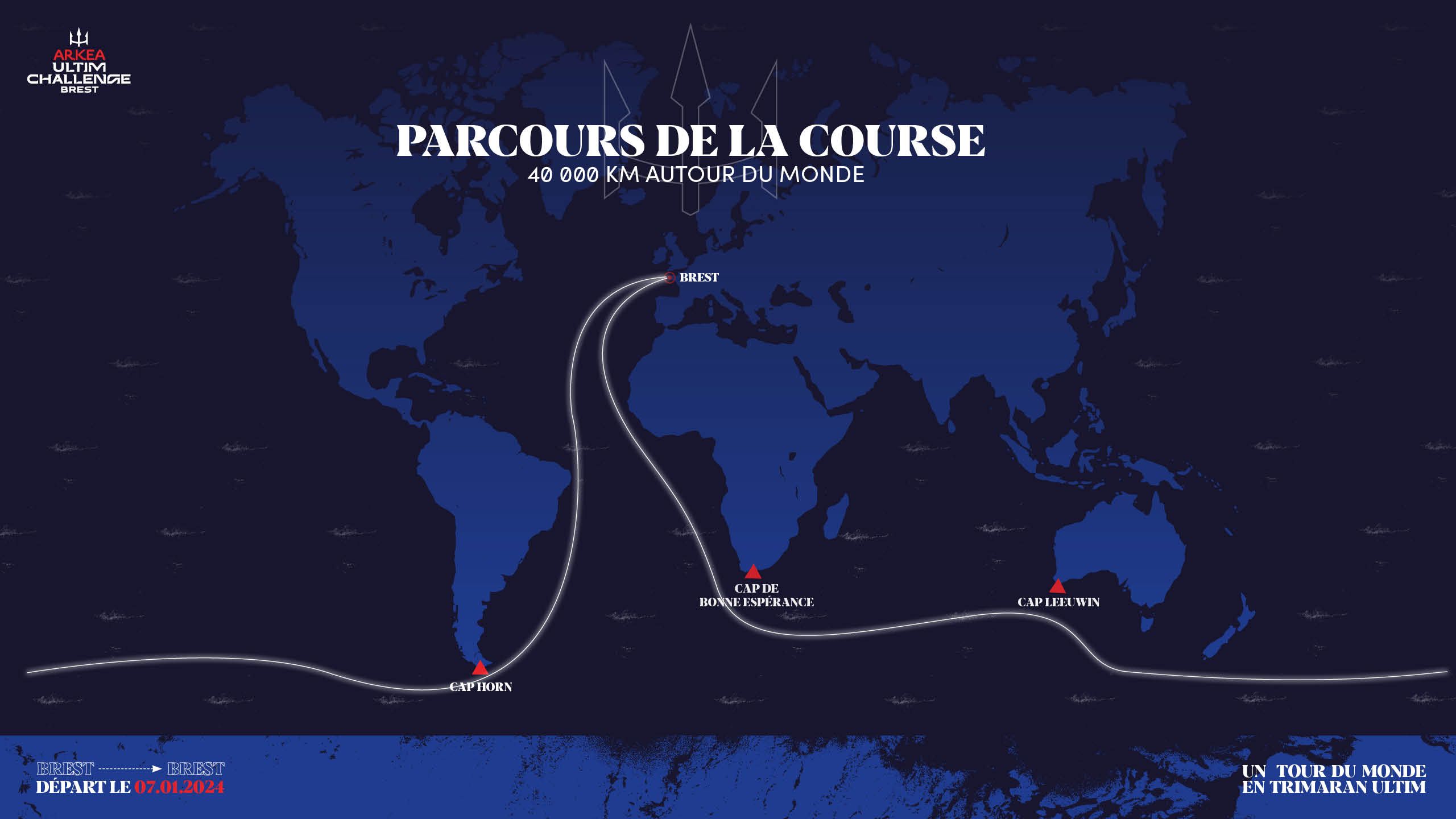
There will be six “Giants of the Seas” to set off from Brest, with a solitary skipper on board, who will attempt to complete a circumnavigation of the world from West to East, via the 3 capes (Good Hope, Leeuwin and Horn). . A human and technological challenge carried by the sailors of the Ultim 32/23 Class accompanied by their shipowners and partners.
Some of them have already completed the journey in a multihull and single-handed: Francis Joyon, Dame Ellen MacArthur, Thomas Coville, François Gabart; notably as part of solo round the world record sailing campaigns, but no one has ever done it in a race!
Alone, on their giant multihulls, for 40 to 50 days, the skippers will be subjected to extreme variations in weather conditions and will have to deal with wind, waves, swell and ice. Anticyclonic systems, with little wind, as well as depressions, most often causing strong winds, will punctuate the life of sailors on board and influence the trajectory strategies adopted.
Sailing around the world is above all a climatic journey: the descent of the Atlantic, the crossing of the Indian Ocean and then the Pacific until heading north again up the Atlantic...
First between Brest and the Cape of Good Hope, the route is punctuated by the passage from one hemisphere to the other through the “Doldrums” also called “intertropical convergence zone (ITCZ)”. The atmosphere in this area mixes warm and humid air masses carried by the trade winds of the Azores anticyclones in the North Atlantic, and that of Saint Helena in its southern equivalent. They generate unstable air where white calms and stormy squalls alternate without any real logic, already requiring increased vigilance during this first part of the race to escape this trap as quickly as possible.
Then comes the longest and most difficult part, which consists of taking advantage of the weather phenomena coming from the west to slide between Good Hope and Cape Horn via Cape Leeuwin. This crossing of the two oceans of the southern hemisphere: the Indian and the Pacific, makes up 3/5ths of the solo world tour. It requires sailors to maintain their trajectory on a downwind course while dealing with sequences of disturbances driven by powerful northwest winds, the passage of squall fronts and icy wind shifts, and this without however being absorbed by anticyclonic conditions... A demanding heterogeneity for navigators as well as for machines...
Finally, the passage of the legendary Cape Horn marks the return to Brest, with around 8,000 miles to go to reach the port of arrival. Before that, the competitors will once again have to deal with the Saint Helena anticyclone, the stormy depressions of Brazil, the stuckness of the Doldrums, the trade winds of the northern hemisphere, and potential Atlantic depressions requiring concentration. extreme of the sailors until crossing the long-awaited finish line in the harbor of Brest.
A race and extraordinary sailors!
Few of them are able to take up the challenge of this race, and this is what makes them atypical human beings, with exceptional physical abilities. These sailors will put their immense physical and mental abilities to the test, forced by the race format to face extremely difficult conditions and their own limits. It is the “lonely” effect facing one of the most hostile elements on the planet, which will reinforce in each of the skippers involved their aura of hero and which will allow the general public to measure the height of the feat that they will realize.
The Great Turning
History seen by
In the minds of offshore racers obsessed with solo sailing, the real turning point came in December 1978 when the Canadian Mike Birch, defying all predictions, won the first Route du Rhum after a final bitter tacking duel[ 1] along the Guadeloupean coast against the large monohull of Michel Malinowski. The sports dailies headlined “the victory of David against Goliath”, because a small 11.30m trimaran had defeated, in everyone’s eyes, a 23m monohull.
As a young offshore racer crowned with two victories in the recent crewed round-the-world race, I dreamed of lining up on the next OSTAR, the queen of solo races won twice by my master and spiritual father in terms of sailing Eric Tabarly. From Plymouth to Newport, it is a course almost exclusively against the wind and I had it in my head to build a “wind machine” asking my friend from La Rochelle, the young architect Philippe Briand, to design a monohull for me. 60 feet, 18m30, the maximum authorized size.
After listening to the finish of the race on the radio and then analyzing the adventures and the journey of the two boats, it seemed obvious to me to acquire a trimaran. Too bad for Philippe! I immediately contacted Walter Greene, the builder of Mike Birch's boat and expert in this new American school who was going to design me an extraordinary 45-foot (13m70) trimaran, Gauloises 4.
Multihulls enter the arena
Indeed, until Mike Birch's surprise victory, multihulls, inspired by Polynesian canoes, had the reputation of boats that were certainly fast and downwind, but used in light airs and against the wind. They were also thought to be fragile and dangerous.
The only truly high-performance racing trimaran, Pen Duick IV, which later became Manureva, was designed by André Allègre for Eric Tabarly in 1968 since the latter, always as visionary, had decreed that "the future of single-handed racing would be played out in multihull”!
Finally, before the victories of Mike Birch on the Route du Rhum 78 and Phil Weld (Moxie) on the OSTAR in 1980, multihulls had not really convinced people to race solo. It is thanks to these indisputable successes and also to the surge in “sponsorship” that between 1980 and 1984 multihulls experienced a real boom!
This is also when we start to become interested in foils. Eric Tabarly first with his boat Paul Ricard, with which he beat the crewed Atlantic record, followed by a series of foiling trimarans of around fifteen meters designed by Marc Lombard, a talented young naval architect to whom we will later have the first retractable appendages, then the giant Charles Heidsieck, Ollier design of 26 meters.
Catamarans with exponential dimensions
In 1984, after a second edition of the Route du Rhum won by a 20-meter catamaran (Elf Aquitaine by Marc Pajot), the wheel turned in favor of the latter, more suited to the competitions of the four years to come. After numerous discussions on the length of the boats, first set at 20 meters by the racers' assembly (ACIMO) then exceeded exponentially, the first giant catamarans of the seas appeared: Tag Heuer 24 meters, Fleury Michon, Charente Maritime, Royale, all approaching 26 meters!
Back to basics on trimarans
But quickly, solo sailors will return to trimarans, first of all for safety reasons. Indeed, to be efficient, catamarans must sail with the windward hull out of the water, a navigation technique adapted to the crew but less to the solo sailor who spends around fifty percent of his time at the helm. To avoid capsizing, it is then obligatory to reduce the sail of the boat, which obviously affects its speed.
Philippe Poupon was well aware of this since he chose a 75-foot (22.85m) trimaran to win the Route du Rhum in 1986. This race proved to be a massacre for maxi-multihulls with the capsizes of Royale (disappearance of its skipper Loïc Caradec), of Jean Stalaven, the abandonments of Charente Maritime, Côte d'Or, Roger et Gallet, Apricot, Jet Services. It encourages the organizers to align themselves with the British and limit the size of the boats to 60 feet for the next solo races. This will be a blessing in disguise since the new generation of ORMA trimarans, all equipped with the first foils to lighten the floats and prevent the front of the boat from crashing into the waves, will allow a first draft of the gigantic supporting plans of today today.
The 21st century and its trimarans over 100 feet
That said, these boats, perfect for crossing the Atlantic, do not correspond to crewed “round-the-world” flights. Which explains that at the dawn of the 21st century, the construction of the first real giant trimarans approaching or exceeding 100 feet in length (30m) and intended as a priority for the Jules Verne Trophy (crewed round-the-world record) will be launched.
The first in the series being Géronimo by Olivier de Kersauson (34m) built at Multiplast in Vannes in 2001 and the largest Spindrift, ex-Banque Populaire, 40 meters long and 23 wide, also designed in 2008 by the firm of VPLP architecture.
Without forgetting the maxi catamarans designed by Gilles Ollier and built in the early 2000s still at Multiplast: Innovation Explorer (32m80) skippered by Loick Peyron for The Race (the only crewed round-the-world race in multihulls), followed in 2003 by the juggernaut Orange 2 (36m80) led by a team of 13 people, a record boat establishing in 2005 a new reference time around the world in 50 days 16 hours with an hourly average of 17.9 knots!
But the real return of the solitary giants will take place in 2010 with the victory of Franck Cammas on the Route du Rhum (run again without size limit) aboard his fabulous 31m50 trimaran, Groupama 3 initially designed to tackle the Trophy Jules Verne. With this boat and this feat Franck will pave the way for solo round-the-world record attempts on maxi trimarans and will contribute to the birth of the Ultim Class. François Gabart will be inspired to design his first Macif, a 32-meter trimaran with which in 2017 he will erase the previous performances of Francis Joyon in 2008 (57 days 13 hours 4 minutes), of Thomas Coville in 2017 (49 days 3 hours 4 minutes), with a new reference time of 42 days 16 hours 40 minutes which should not make us forget the first daredevils to dare such a feat, Philippe Monnet (1986 - 129 days), Olivier de Kersauson (1989 - 125 days), Ellen MacArthur (2004 - 71 days)!
This will foreshadow the next ultimate race, that of all superlatives, which will leave Brest at the end of 2023, the first race around the world by the three capes, solo and in a multihull, the major event in the history of ocean racing, the ARKEA ULTIM CHALLENGE - Brest, which will see the world's largest flying trimarans compete on the oceans led by the most daring skippers.
[1] Tacking: tacking as close as possible to the wind, necessary to take a course facing the wind without being stopped (because a boat facing the wind cannot move forward)