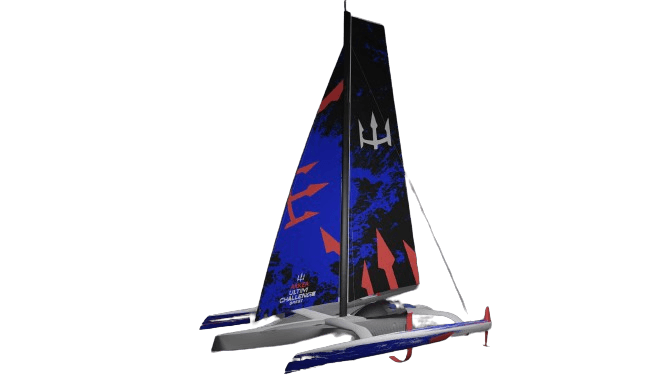


The boats
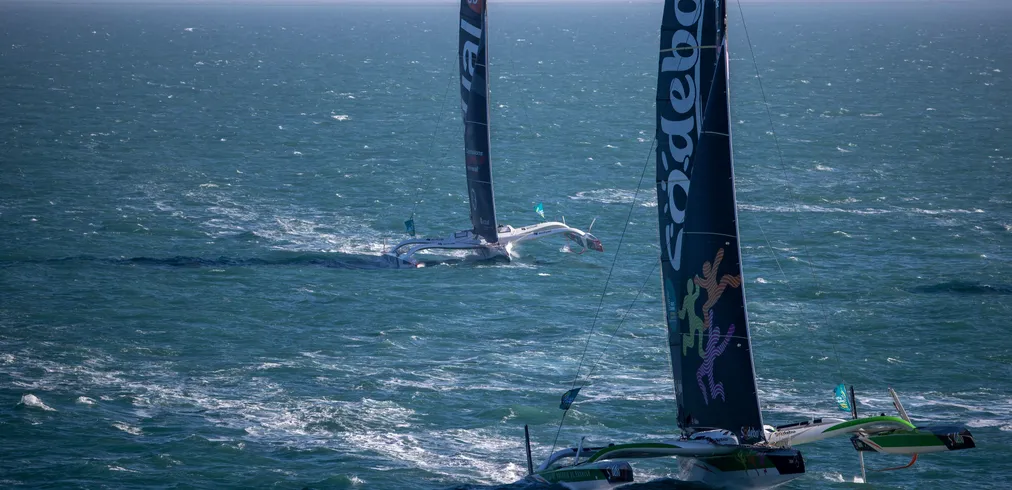
In just ten years, the most prestigious multihulls have evolved to become ULTIMs. These giants of the seas have the ability to fly over the ocean almost permanently. Xavier Guilbaud, architect associated with VPLP, has played a central role in these radical transformations.
ULTIM 32/23
The genesis
From the late 1990s onwards, designers were convinced that sailing should take place in the central hull rather than on the floats. This approach was motivated both by performance considerations, such as the rigidity of the central hull to hold the rig longitudinally and the freedom to position the mast, as well as safety concerns. When designing Groupama 3, their aim was to create a yacht capable of circumnavigating the globe while being the smallest of the big boats, and to do so on a more reasonable budget. It weighed almost half as much as the Orange II, which was the benchmark at the time, when it was launched. Groupama 3's exceptional performances, such as her victory in the Jules Verne Trophy in 2010 and the Routes du Rhum in 2010 and 2014, then served as a benchmark for the ULTIM classification rules.
Flying, a new era
Groupama 3 was an extrapolation of the Orma catamarans of her time, while remaining an archimedian type boat. The next transition, which began with Macif, was aimed at the ability to fly above the water.
"We were able to make the float fly, then the central hull acted as a shock absorber and contributed to the balance in heel and trim, like the tripod on a bicycle," explains Xavier Guilbaud.
Since then, the teams have endeavoured to extend the duration of the flight as much as possible while maintaining high average speeds, an evolution largely influenced by the advances introduced by Gitana and adopted by other sailing boats.
Reliability has emerged as a major concern, with new certainties developing. The move to flying, especially upwind, has introduced increased impacts from the sea, particularly on the arms and undersides of the hulls. Damage in 2018, among others, has provided valuable lessons, leading to the strengthening of existing boats and the design of stronger, more reliable models. Although zero risk remains an illusion in ocean racing, partly due to UFOs (Unidentified Floating Objects), the class has evolved considerably in its risk management.
Improving performance
The significant improvement in performance stems from the principle of flight. The load-bearing surface on the new generation is twice as large, enabling the multihulls to take off from 12 knots of real wind. The ULTIMs can therefore fly upwind and downwind in up to 25 knots of real wind and 3 metres of waves. Beyond these conditions, as Armel Le Cléac'h (Banque Populaire XI) explains, the boat's behaviour is highly dependent on the characteristics of the sea. In crossed or rough seas, the boat's behaviour can change considerably. Above 3 metres of waves, the flight partially transforms into a more hybrid mode, called skimming. In this mode, the older generations of trimarans can still compete. As a result, flying imposes new routing imperatives, with the search for the average wind becoming the key to performance.
In favourable wind conditions, reaching an average speed of 35 knots for several hours has become commonplace, and peaks in excess of 45 knots are frequent. Maintaining high speeds while preserving the boats' potential over time is one of the major challenges of the ARKEA ULTIM CHALLENGE - Brest.
What does ULTIM look like ?